
METHOD ROLE
Define what the result means.
Separate localization, screening, monitoring and prioritization from defect confirmation or fitness-for-service decisions.
RAVAM qualifies new sensing and intelligence workflows through documented requirements, controlled testing, field correlation, independent review and operator acceptance.
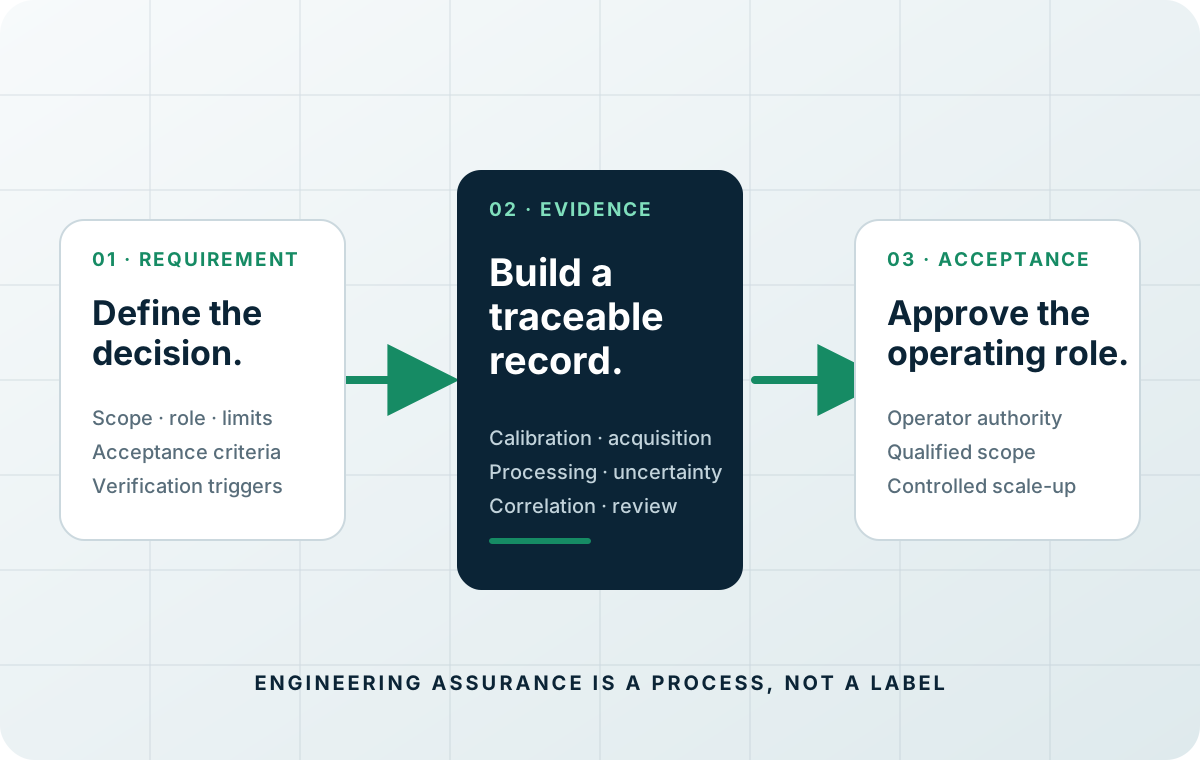
RAVAM does not present UAV magnetometry, remote sensing or AI as replacements for established pipeline integrity methods. Each capability is assigned a specific decision role and an evidence pathway appropriate to the operator and jurisdiction.
Separate localization, screening, monitoring and prioritization from defect confirmation or fitness-for-service decisions.
Record calibration, geometry, background conditions, interference, processing history and confidence.
Define verification triggers and acceptance criteria with the operator before operational scale-up.
These frameworks may inform project requirements where applicable. Final compliance obligations and editions are confirmed with the operator, competent engineers and relevant authorities.
| Assurance area | Reference framework | RAVAM application |
|---|---|---|
| Pipeline integrity management | ISO 19345-1 and ISO 13623 | Life-cycle integrity context, operating requirements and the relationship between evidence and engineering decisions. |
| External corrosion direct assessment | AMPP SP0502 | Structured relationship between pre-assessment, indirect inspection, direct examination and post-assessment. |
| Underground utility investigation | ASCE/UESI/CI 38-22 and PAS 128:2022 | Survey planning, evidence quality, location confidence and standardized documentation of existing utilities. |
| Inspection-system qualification | API Standard 1163 | Useful qualification principles for performance specification, verification, validation and reporting; not a claim that UAV magnetometry is ILI. |
| Asset-data governance | ISO 55001:2024 | Governance of asset information, risk, life-cycle decisions and continual improvement. |
| Industrial cybersecurity | IEC 62443 series | Security requirements for integrations involving industrial automation, control systems and service providers. |
| Regional and operator requirements | Applicable Serbian, EU, national, GOST and operator standards | Project-specific compliance matrix identifying governing law, technical rules, contract requirements and acceptance authority. |
Public and contractual language should distinguish measured observations, interpreted anomalies, verified conditions and confirmed defects.
The exact program depends on pipeline construction, operating history, available ground truth, terrain and the decisions the operator intends to make.
Define use case, performance questions, exclusions, datasets and acceptance authority.
Verify sensor behavior, calibration, repeatability, interference controls and processing traceability.
Compare observations with known pipeline features, records and selected direct evidence.
Test the method against undisclosed locations or conditions using agreed statistical measures.
Document results, limitations, operating procedures and the approved scope for deployment.
The project record connects field acquisition to processing, interpretation, verification and the final operator decision.
Connections to GIS, CMMS, ERP, SCADA or other operational systems are designed around least privilege, traceable interfaces, operator ownership and appropriate separation from safety-critical control.
Access, retention, hosting and export requirements are agreed contractually.
Authentication, authorization, logging, segmentation and change management match the integration risk.
Safety-critical actions require separate authorization, engineering and validation beyond analytics or alerting.
RAVAM can develop a qualification plan around the operator's pipeline, available ground truth and required decisions.