Intelligence That Sees What Humans Miss
Our AI engine doesn’t rely on a single sensor. It cross-references every data layer — thermal, magnetic, visual, spectral — to eliminate false positives and detect defects that no single sensor can find alone.
The Processing Pipeline
Every byte of sensor data flows through a five-stage pipeline — from raw ingestion to actionable alert.
Ingest
Raw multi-sensor data streams received from drone and nest
Calibrate
Geo-reference, normalize, and align sensor data layers
Fuse
Cross-reference multiple sensor types into unified scene
Classify
ML models detect, classify, and score anomalies
Act
Alerts, reports, predictions pushed to Command Center
Фузија више сензора
The key to 95%+ accuracy isn’t better individual sensors — it’s what happens when you cross-reference all of them simultaneously.
Fusion Engine
Spatial alignment • Temporal sync • Cross-validation • Confidence scoring
Why fusion matters: A thermal hotspot alone could be solar heating. A magnetic anomaly alone could be geological noise. But a thermal hotspot at the same GPS coordinate as a magnetic anomaly and a visual surface crack — that’s a confirmed defect with near-zero false positive probability. Each additional sensor layer doesn’t add accuracy linearly — it multiplies confidence exponentially.
Four Model Families Working Together
No single model does everything. Our engine runs specialized models in parallel, each trained for a specific data domain, with an ensemble layer that combines their outputs.
👁 Visual Defect Detection
Convolutional neural networks trained on infrastructure-specific imagery. Detects cracks, corrosion, vegetation encroachment, equipment displacement, and structural deformations from RGB and zoom camera feeds.
🌡 Thermal & Magnetic Anomaly
Gradient-based classifiers for thermal imaging and magnetometer data. Identifies pipeline corrosion signatures, electrical hotspots, gas leak thermal plumes, and subsurface anomalies using multi-component magnetic field analysis.
📉 Predictive Degradation
Recurrent models analyzing time-series data across repeated survey flights. Builds degradation curves per asset segment and forecasts failure timelines weeks to months ahead, with confidence intervals.
🎯 Ensemble Classifier
The meta-layer. Combines outputs from all three model families with sensor fusion confidence scores to produce final risk assessments. Weighted by site-specific calibration data to reduce noise in each environment.
Edge + Cloud Processing
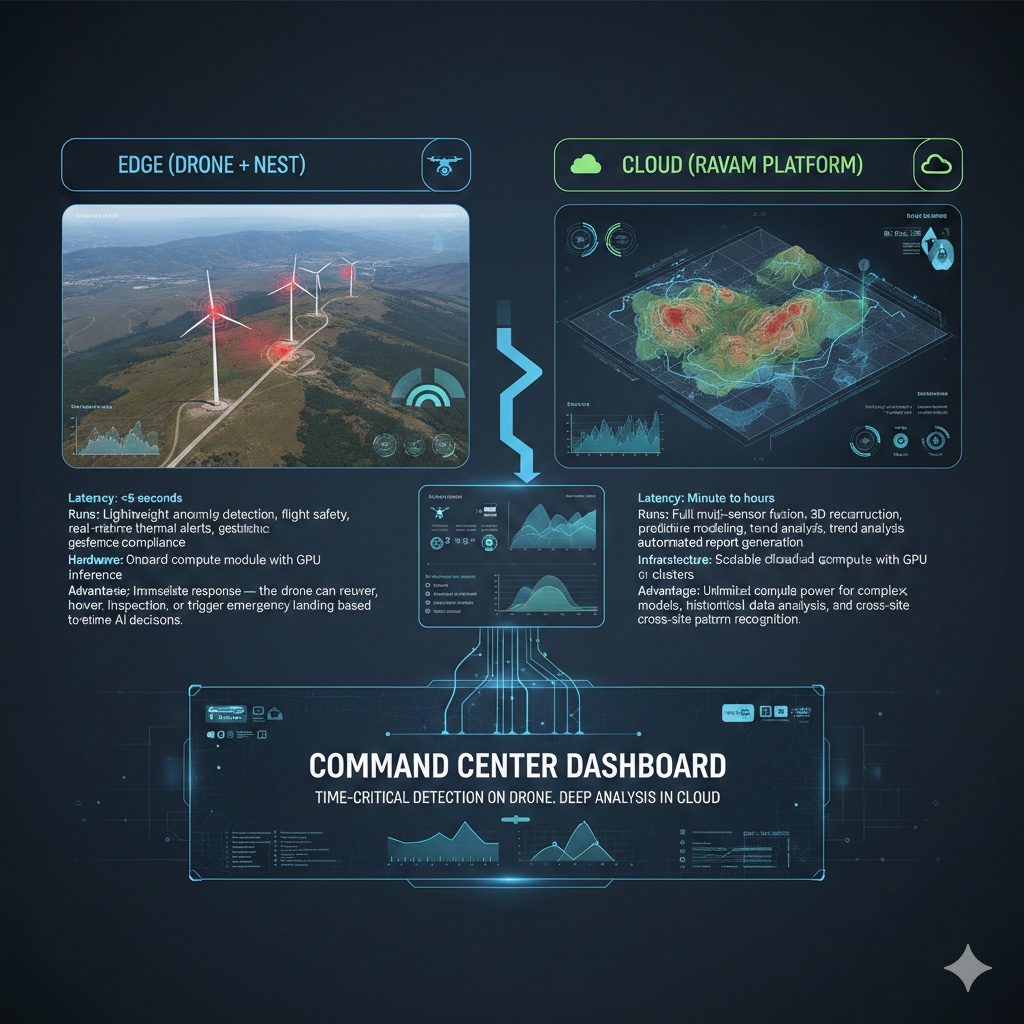
Time-critical detection happens on the drone. Deep analysis happens in the cloud. Both feed the same Command Center dashboard.
⚡ Edge (Drone + Nest)
Latency: <5 seconds
Runs: Lightweight anomaly detection, flight safety, real-time thermal alerts, geofence compliance
Hardware: Onboard compute module with GPU inference
Advantage: Immediate response — the drone can reroute, hover for closer inspection, or trigger emergency landing based on real-time AI decisions
☁ Cloud (RAVAM Platform)
Latency: Minutes to hours
Runs: Full multi-sensor fusion, 3D reconstruction, predictive modeling, trend analysis, automated report generation
Infrastructure: Scalable cloud compute with GPU clusters
Advantage: Unlimited compute power for complex models, historical data analysis, and cross-site pattern recognition
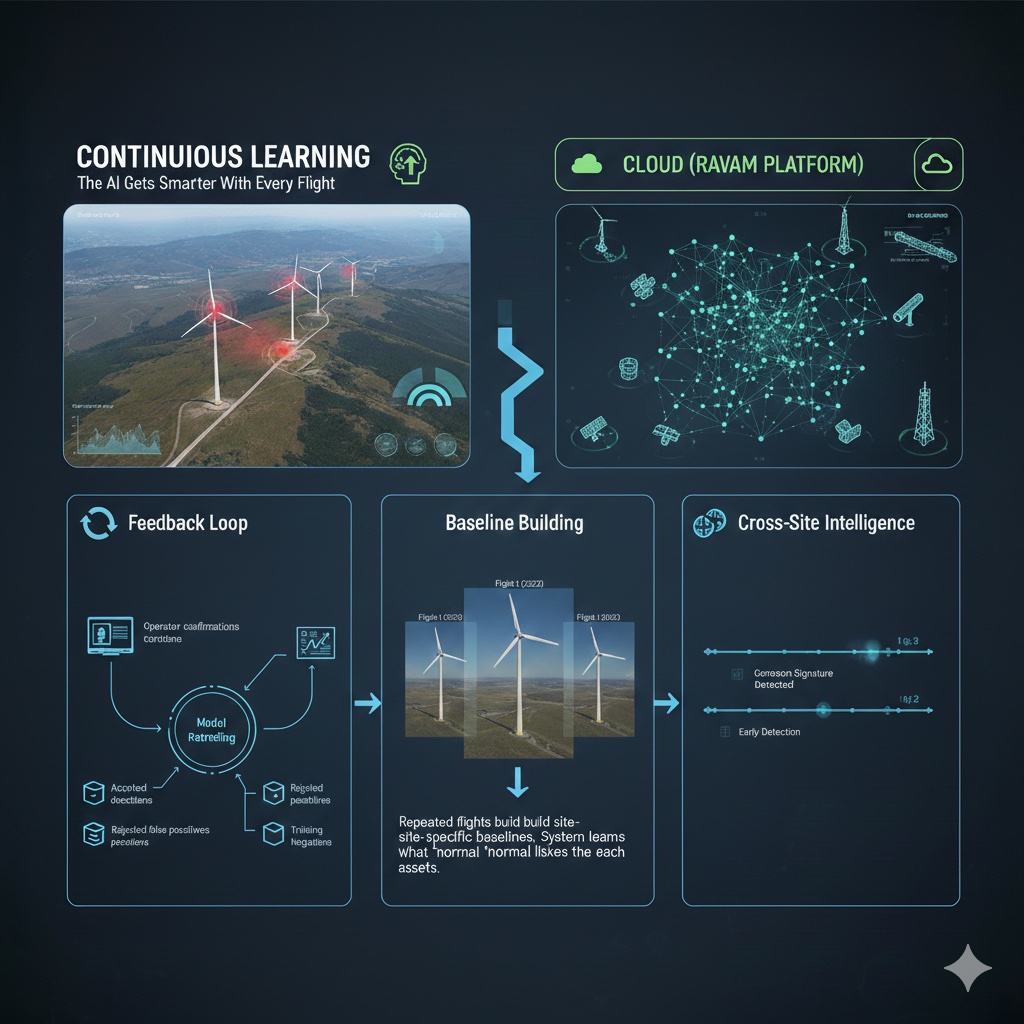
The AI Gets Smarter With Every Flight
Our models aren’t static. Every confirmed detection, every false positive correction, every new survey adds to the training data and improves accuracy over time.
🔄 Feedback Loop
Operator confirmations and corrections from the Command Center feed directly into the model retraining pipeline. Accepted detections reinforce the model. Rejected false positives are labeled as training negatives.
📅 Baseline Building
Repeated flights over the same infrastructure build site-specific baselines. The system learns what “normal” looks like for each asset segment, making anomaly detection increasingly precise with each survey cycle.
🌐 Cross-Site Intelligence
Patterns detected at one site inform models at similar infrastructure elsewhere. A corrosion signature identified on Pipeline A helps detect the same signature earlier on Pipeline B.
Detection Capabilities by Domain
The engine is trained for infrastructure-specific defects across every industry RAVAM serves.
🛢 Oil & Gas Pipelines
Corrosion zones, metal loss, joint degradation, weld anomalies, magnetic field shifts indicating wall thickness changes, thermal plumes from leaks, right-of-way encroachment
⚡ Power Lines & Grid
Hotspot detection on conductors and transformers, insulator damage, vegetation clearance violations, tower structural displacement, conductor sag measurement
☀ Solar Farms
Panel hotspots (cell/string failures), soiling detection, tracker misalignment, inverter thermal anomalies, vegetation shading analysis, performance degradation mapping
⛏ Mining & Exploration
Mineral deposit signatures, geological boundary identification, fault line mapping, subsurface void detection, tailings dam structural monitoring, environmental compliance
🚂 Railway
Track geometry anomalies, rail surface defects, ballast degradation, signal equipment status, bridge structural monitoring, vegetation clearance
🏗 Construction & General
Progress tracking via change detection, stockpile volumetrics, structural settlement monitoring, thermal envelope analysis, erosion detection
AI Engine FAQ
See the AI Engine in Action
Request a demo with real infrastructure data, or discuss how RAVAM’s AI can process your sensor data.